The file answers the wrong questions
Sponsors often lead with the vision. A Gulf investment committee wants risk allocation, revenue certainty, guarantees and a credible exit. Without those answers, the file is politely set aside.
A sound project in Nairobi or Dakar and an investor in Dubai can want the same outcome and still never sit at the same table. The missing piece is rarely money. It is preparation, access and trust, and that gap is where an Africa UAE Advisor earns their place. From Dubai, Africa Business Club Consultancy prepares projects for scrutiny, puts them in front of the right counterparts and stays involved until terms are on paper.
Between 2019 and 2023, the UAE invested more than US$110 billion across Africa, which places it among the continent’s largest investment partners. That money did not go into a single industry. It reached energy and renewables, transport and utility infrastructure, ports and logistics, real estate, agriculture and tourism.
Geography helps too. Dubai is a short flight from most African capitals and home to banks, funds and family offices used to cross-border deals. For African entrepreneurs seeking Gulf capital, it is an accessible first stop where decision-makers can realistically be met.
What deserves attention in 2027 is the kind of project now on the table. Power plants, port concessions, logistics hubs and large-scale farming take years to deliver and involve public authorities at every stage. They reward patient capital and careful structuring. They punish improvisation.
Most projects that never reach financing were not bad ideas. They stopped at predictable points, most of which careful preparation can avoid.
Sponsors often lead with the vision. A Gulf investment committee wants risk allocation, revenue certainty, guarantees and a credible exit. Without those answers, the file is politely set aside.
Funds and family offices receive more proposals than they can read. A message with no trusted introducer rarely gets a reply.
In a PPP, investors need to see the ministry, regulator and contracting authority aligned. Unclear land status can end talks early.
Decisions are made differently in Abu Dhabi, Abidjan and Addis Ababa. Misreading the other side’s pace can cost months.
For investors abroad, telling ready projects from announced ones, and knowing who decides, is hard from a distance.
The value of an advisor lies in specific tasks, not in a title. On this corridor, the work usually falls into five areas.
Reviewing the project before investors do: financial model, legal structure, permits and the questions a committee will raise.
Shaping the deal, whether equity, debt, a PPP concession or a joint venture, so each side can approve it internally.
A short list of investors, developers or lenders whose mandate fits, introduced with context instead of a mass mailing.
Engaging ministries and public agencies early, so the public side of the project is visible and credible.
Staying involved after the first meeting, through due diligence, negotiation and the term sheet.
A capable Africa Advisor helps you read a market before committing to it: who actually decides, which incentives hold up in practice and which projects are ready rather than simply announced.
Here the work of a UAE Advisor runs the other way: explaining how capital is allocated in the Gulf, which institutions fit your sector and how to present a project so that it survives the first internal review.
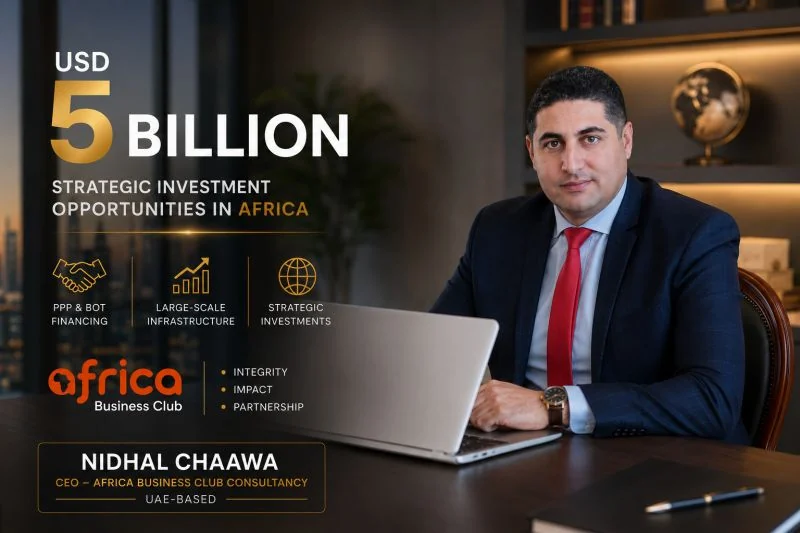
Africa Business Club Consultancy is a Dubai-based strategic advisory firm that acts as a bridge between Africa and international markets. Its CEO, Nidhal Chaawa, is a Tunisian entrepreneur who has built his practice in Dubai.
He brings more than 14 years of business leadership and over 33 completed projects, along with strategic partnerships across Africa and the GCC. His engineering background shapes the way he reads a file: technical feasibility first, then the financial and contractual structure around it.
He works in Arabic, French and English. On this corridor that is a practical advantage, since one transaction can bring together a Gulf investor, a French-speaking ministry and an English-speaking lender.
Partners on both sides regard him as an experienced Africa Advisor and a recognised voice on Gulf investment in African projects.
Sensitive negotiations rarely benefit from publicity.
Mandates are accepted when they can genuinely move forward.
Follow-up is built into every mandate.
Consider a generic case. A public authority wants to develop a logistics platform next to a port. A feasibility study exists and the relevant ministry supports the plan. What is missing is a partner able to invest in the platform and run it.
Documents are reviewed and gaps listed plainly, such as an unclear revenue model or unresolved land titles.
Options are set out, from a concession to a phased PPP, and the authority chooses one it can defend publicly.
A short list of Gulf port operators, infrastructure funds and developers is prepared, with discreet introductions in Dubai.
Investor questions are answered quickly while government relations keep the public side responsive.
Negotiation moves toward an agreement both parties can sign and finance.
None of these stages is dramatic. Projects move forward because each one is handled properly, and in the right order.
Whether you represent a project or a pool of capital, a first meeting is far more productive when a few elements are ready.
If some of this is still missing, that is normal. Part of the advisor’s role is to work out what is needed, and in which order.
The role is to give the investor a reliable picture of an African market and its opportunities: who the decision-makers are, how regulation works in practice and which projects are ready for capital. It can extend to representation during negotiations with local partners and public authorities.
Ideally before approaching investors, not after a series of unanswered emails. Early involvement lets the file be adjusted to what Gulf institutions expect, which saves time on both sides.
Mainly energy and renewables, infrastructure, ports and logistics, real estate, agriculture and tourism, with particular attention to large public projects and PPPs.
Yes. Government relations and public-private partnerships sit at the centre of the work, so ministries, public agencies, private sponsors and international companies are all typical counterparts.
Yes. Discretion is part of how the firm operates, and documents can be exchanged under a non-disclosure agreement from the outset.
Whether you need a UAE Advisor to reach Gulf investors or support to enter an African market, the first step is a short, confidential conversation. Nidhal Chaawa and the Africa Business Club Consultancy team can be reached directly.